

Why Wear Colourful Gemstone Jewellery: 7 Reasons
Table of Contents
- Why We All Ended Up Wearing Beige
- What Colourful Gemstone Jewellery Does to a Plain Outfit
- The Traditional Meaning of Gemstones in Jewellery
- Handcrafted Gemstone Jewellery Australia: Why the Story Matters
- Maximalist Jewellery Styling Without Looking Like a Costume
- How to Layer Gemstone Necklaces So They Actually Work
- Building a Jewellery Story You Collect Over Time
- Frequently Asked Questions
Last Updated: September 22, 2026
Why We All Ended Up Wearing Beige
In a world of reducing traditions and homogenized culture, people somehow began to think that good taste meant no colour. Wardrobes have filled up with greys, creams and camel. Jewellery got smaller, quieter, safer. We weren't born for beige, but we were certainly dressed in it.
This guide from Sixth Dimension Gems is about the other path: choosing colour, texture and stone. Because colourful gemstone jewellery is not a trend to be tolerated. It is a way of saying something about yourself without opening your mouth.

But thank goodness- the shift is happening. Colour has returned to runways and street style, and jewellery is leading it. Meanwhile, quieter pieces keep doing the same job they have always done: disappearing against skin and fabric.
Here is the thing most style advice gets wrong. Minimalism is not automatically more sophisticated than colour. A plain gold band and a stack of carved gemstones are both choices. Only one of them starts a conversation.
What Colourful Gemstone Jewellery Does to a Plain Outfit
The fastest way to understand the power of colourful gemstone jewellery is to test it against a plain outfit. A black dress with a beaded necklace reads completely differently to the same dress worn bare.
Colour changes the mood of an outfit before anyone has processed the details. A warm citrine yellow can evoke optimism. Deep lapis blue can suggest confidence. Turquoise can feel open and sunlit. None of that is decoration for decoration's sake. It is the piece doing the emotional work of the whole look.
That is why colour should be treated as energy, not as an accessory afterthought. You are not matching a bag. You are setting a tone.
Colour as Energy, Not Decoration
Think about how you choose a lipstick. You do not pick the one that blends in. You pick the one that changes your face. Gemstones deserve the same logic.
A few practical ways to think about it:
- Warm stones like citrine, carnelian and amber bring heat and optimism to an outfit
- Cool stones like turquoise, lapis lazuli and blue topaz bring clarity and calm
- Soft stones like moonstone and rose quartz bring a gentler, more reflective mood
- Deep stones like onyx and dark agate bring weight, contrast and drama
Choose the mood you want, then choose the stone.
The Traditional Meaning of Gemstones in Jewellery
The meaning of gemstones in jewellery runs deeper than most people realise. Across many cultures, particular stones have carried traditional associations for centuries, and those associations are still part of why certain pieces feel significant to wear.
It is worth being clear about what this is. These are cultural and spiritual traditions, not scientific claims. But the human habit of assigning meaning to colour and stone is very old, very widespread, and worth understanding.
Citrine, Amethyst, Turquoise: What Each Stone Has Meant
Different stones carry different traditional stories. Here are a few that show up again and again:
- Citrine has long been associated with warmth, abundance and sunlight in Western folk tradition
- Amethyst has carried associations with clarity and calm since ancient Greek and Roman times
- Turquoise has been significant across Persian, Native American and Tibetan cultures, often linked to protection
- Moonstone has traditionally been tied to cycles, intuition and the moon in several cultures
- Chalcedony appears in ancient carving traditions, valued for its soft translucency
- Carnelian has been used in seals and amulets for thousands of years
- Agate has been carved and worn across many cultures for its banded patterns and perceived grounding qualities
You do not have to believe any of it. But choosing a stone because its story resonates with you is a completely different act from buying whatever is on the shelf.
Handcrafted Gemstone Jewellery Australia: Why the Story Matters
The Handcrafted gemstone jewellery Australia buyers return to again and again tends to share one quality: you can trace where it came from. Mass-produced pieces are anonymous. You have no idea who designed them, who made them, or what they were thinking.
That anonymity is exactly what makes them feel disposable.
Sixth Dimension Gems works differently. Every piece is designed by Australian contemporary abstract artist Louisa de Haas, then crafted by master artisans in Jaipur, India, or hand-beaded in Louisa's studio in the Southern Highlands of NSW. Louisa travels to India to source beads and materials herself, and many pieces are one-off or made in small, collectible batches.
That matters more than it sounds. When a piece is one of only two, you are not wearing a product. You are wearing a decision someone made.
There is also a practical side. Knowing that a bracelet is gold-plated brass, always nickel-free, and finished with an adjustable link chain provides insight into its wear. Knowing a ring is handmade to order in Jaipur and takes three to five weeks for Australian delivery tells you it was not pulled off a shelf.
That is what jewellery with a soul actually means. It is not mysticism. It is provenance.
Maximalist Jewellery Styling Without Looking Like a Costume
Maximalist jewellery styling fails for one reason: too many competing ideas at once. The fix is not to wear less. It is to give the eye somewhere to land.
The most reliable approach is to anchor the outfit and let the jewellery do everything else. A plain black top, a white shirt, a simple slip dress. Then go big with stone, scale and colour. The contrast does the work.
A few rules that hold up in practice:
- Pick one focal point. If the necklace is loud, keep the earrings quieter, and vice versa
- Repeat a colour once. Two hits of turquoise across a look reads intentional. Five reads accidental
- Mix metals deliberately. Gold-plated brass next to sterling silver is a choice, not a mistake
- Let textures clash. Smooth faceted stones against chunky raw beads creates depth
- Ignore the old matching rule. Who decided your jewellery has to match your outfit, your bag, or each other?
That last point is worth sitting with. The matching rule was never a rule. It was a habit that made people buy more carefully and wear less joyfully.
How to Layer Gemstone Necklaces So They Actually Work
How to layer gemstone necklaces comes down to three things: length, weight and colour. Get those right and layering becomes almost automatic.
Start with a base layer that sits close to the collarbone. Add a mid-length strand with a different bead size. Finish with something longer that carries a pendant. Vary the drop between each strand so they do not tangle.
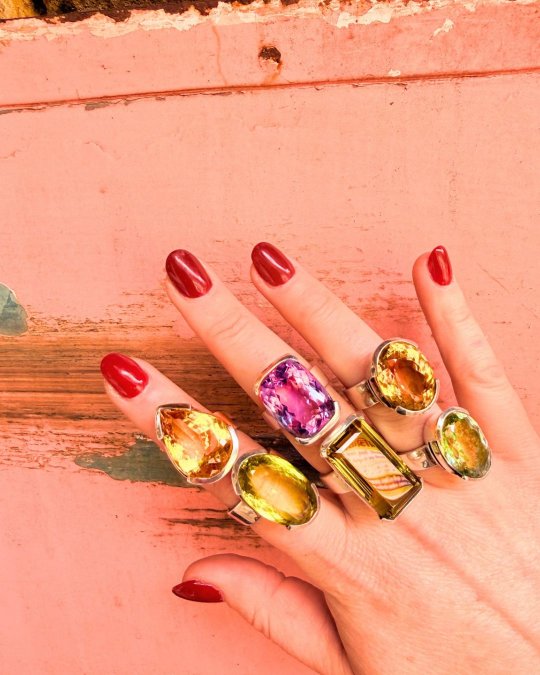
Colour is where most people hesitate. The instinct is to keep everything in one family. Resist it. A purple amethyst strand next to a turquoise howlite pendant and a warm carnelian bead can create an intriguing contrast.
Adjustable link chains make this far easier, because you can change the drop without changing the necklace. Pieces like the Technicolour Heart necklace, with its hand-carved green chalcedony heart, moonstone and lapis lazuli, were built for exactly this: three strands, one piece, endless arrangements.

Building a Jewellery Story You Collect Over Time
The best jewellery wardrobes are not bought in one afternoon. They are collected. A piece from a trip. A gift that marks a birthday. Something you bought because the colour made you feel like yourself that week.
Over time, those pieces stop being separate objects and start being a record. That carved flower pendant from the Jaipur flower markets.
Frequently Asked Questions
Why is colourful gemstone jewellery becoming a trend?
Minimalist neutral jewellery has dominated for over a decade, and plenty of women are tired of it. Colourful gemstone jewellery offers something neutral pieces cannot: visible personality. Beaded strands, carved pendants and mixed stones let you build a look that reads as yours rather than a catalogue's. It also fits how people now shop, favouring smaller batches and one-off pieces over mass-produced accessories. The shift is less about fashion cycles and more about wanting jewellery that starts a conversation.
How do I start wearing colourful gemstone jewellery if I usually dress minimally?
Start with one piece and keep everything else quiet. A single beaded bracelet or a hand-carved gemstone pendant against a plain black or white outfit does the work without feeling like a costume. The Jaipur Flowers pendants are an easy entry point because each one is small and carved, so it reads as a detail rather than a full colour commitment. Once you are comfortable, add a second strand or a ring and build from there.
Is it okay to mix metals and colourful gemstones?
Yes, and the rule that you should not mix metals is worth ignoring. Gold-plated brass, sterling silver and rhodium-plated finishes all sit comfortably together when the gemstone colours tie them in. What makes mixing work is repetition: if a warm gold bracelet and a cool silver ring both carry the same green or blue stone, the eye reads them as deliberate. Choose what you love, layer freely, and stop treating metal as a matching set.
Do gemstones actually have meanings, or is that just marketing?
Gemstone meanings come from long-standing cultural and spiritual traditions rather than scientific findings. Amethyst has been associated with clarity and calm in various cultures, turquoise with protection, citrine with warmth and optimism. These are traditional associations, not medical claims, and they are worth treating as such. What matters practically is whether a stone resonates with you. Choosing a piece because the colour or the story appeals to you is a perfectly good reason.