

Maximalist Jewellery Styling Tips for Women
Table of Contents
- Forget the Rules: More Is More
- Start With One Piece That Demands Attention
- Layer Colour Like You Mean It
- Mixing Metals: A Jewellery Guide for Breaking the Rules
- How to Stack Rings, Layer Necklaces and Build an Ear Story
- Let Your Jewellery Tell Your Story
- Confidence Is the Final Accessory
- Frequently Asked Questions
Last Updated: September 25, 2026
Forget the Rules: More Is More
Maximalist jewellery styling tips for women start with one simple shift: stop asking whether a piece is allowed. If minimalist jewellery has always felt a little too safe, this is your permission slip to turn the volume up. At Sixth Dimension Gems, we design for women who want to wear more of themselves, not less.
Maximalist jewellery styling is the art of layering bold, colourful, mismatched pieces with intent rather than restraint. It is not about wearing everything at once. It is about choosing pieces that talk to each other.
That distinction matters, because "more is more" only works when it looks deliberate. Here is how to build a look that reads as confident rather than cluttered.
"We weren't born for beige."
Start With One Piece That Demands Attention
Every maximalist look needs an anchor. Choose one hero piece and let it set the mood for everything else.
A hero piece could be a colourful gemstone necklace, a pair of oversized statement earrings, a bold gemstone ring, or a charm-heavy pendant. It should be the thing people notice first.
Once it is on, build outward. Ask yourself what the hero piece needs, not what you feel like adding. The Charm Theory Earrings work as a hero because the charms move independently, so the earrings catch light and shift as you talk. Light to wear but heavy in impact.

A common mistake is starting with three hero pieces. That is not maximalism, that is noise. Pick one, then support it.
Layer Colour Like You Mean It
Colour is the fastest way to change the energy of an outfit. Combining gemstones, contrasting hues and unexpected pairings turns a plain black dress into something with a pulse.
The trick is to work in families, not matches. Lapis lazuli, turquoise and blue topaz sit comfortably together because they share a cool base. Add one warm piece, like carnelian or a lemon quartz charm, and the whole composition wakes up.
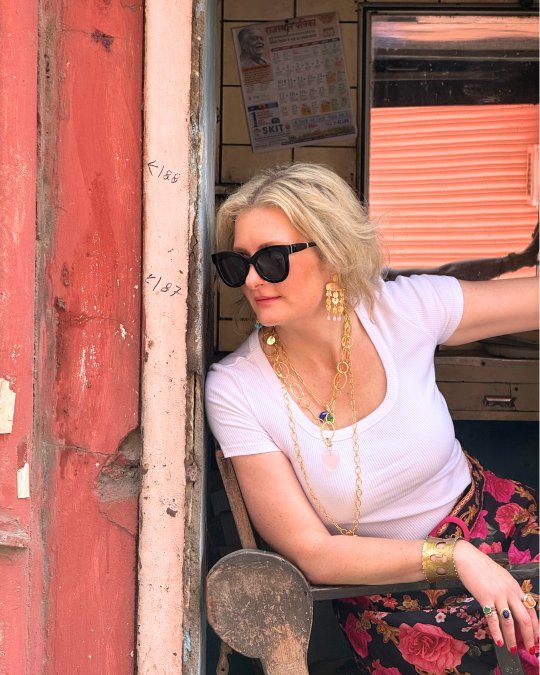
Wearing more colour is not just a styling decision. Many women find that once they start wearing brighter pieces, they stop reaching for the same safe outfit every morning.
What most guides miss is that colour does not need to match your clothes. It needs to match your mood.
Mixing Metals: A Jewellery Guide for Breaking the Rules
Gold and silver can absolutely coexist. Who decided they couldn't?
A mixing metals jewellery guide really comes down to balance. If you are wearing a chunky gold-plated brass chain, add a slimmer sterling silver ring or a fine silver bracelet. The contrast in weight stops the metals from competing.
Three rules that make mixing work:
- Repeat each metal at least twice across the body
- Pair a chunky piece in one metal with a delicate piece in the other
- Use gemstones as the bridge between them
The Charm Chains are a good starting point for mixing because the S-hook clasp lets you adjust the length. That means you can layer a gold chain over a silver one without the lengths fighting each other.

Where it falls short: if every piece is the same weight and finish, mixing metals looks accidental rather than intentional. Vary the texture.
How to Stack Rings, Layer Necklaces and Build an Ear Story
Stacking works when there is a logic underneath the chaos. Vary length, shape, texture and proportion, and the eye reads the whole look as one composition.
Layered Necklace Combinations That Look Intentional
The best layered necklace combinations follow a length ladder. Start short, then step down.
Layer |
Length |
Piece Type |
Purpose |
|---|---|---|---|
1 |
40-45cm |
Fine chain or choker |
Sits at the collarbone |
2 |
50-53cm |
Charm chain |
The focal layer |
3 |
60cm+ |
Beaded or pendant strand |
Adds weight at the base |
The Technicolour Heart sits naturally in the middle or base layer. Three strands of moonstone, rose quartz, agate, lapis lazuli and vintage coral give you a colour story already built in.

Statement Earrings Styling: The Ear Story
Statement earrings styling is about building a stack from the lobe upward. Start with a simple stud, add a hoop, then finish with a drop or charm piece.
Keep one ear heavier than the other if you want an asymmetric look. Charm Theory works well here because each charm moves on its own, so the ear never looks static.
Let Your Jewellery Tell Your Story
The best maximalist collections look accumulated, not purchased in one go. That is the difference between a look that feels like you and a look that feels like a mannequin.
Think about what each piece marks. A trip, a person, a chapter, a version of yourself you are glad you became. A charm collected in Jaipur means something different to a charm bought on a Tuesday because you liked the colour.
The Colour Me Happy bracelet is a good example. Four strands of agate, carnelian, carved rock quartz and vintage amber make it a piece you build a wrist around, not a piece you match to anything.
A common mistake is buying a full matching set. It photographs well once and then feels flat. Collect slowly and layer freely.
Confidence Is the Final Accessory
Maximalist jewellery works because you own it. Not because the colours are correct, not because the metals match, not because someone on the internet said so.
There are no rules in the Sixth Dimension. If a piece makes you stand a little taller, it is the right piece.
Frequently Asked Questions
How do you style maximalist jewellery without looking messy?
Build around one hero piece, then let everything else support it. If your Charm Theory Earrings are doing the talking, keep necklaces simpler or choose a single strand. Vary lengths and textures so pieces sit at different levels rather than competing. The trick is contrast: pair chunky with delicate, polished with playful. Maximalist jewellery styling works when there is a clear focal point and the rest of the look feels deliberately layered, not accidentally tangled.
Can you mix gold and silver jewellery?
Absolutely. The idea that metals must match belongs to a rulebook nobody reads anymore. Mixing gold-plated brass with sterling silver creates visual tension that makes a layered look more interesting. Try layering a gold Charm Chain with a silver pendant, or stack a gold ring next to a silver one. Keep the proportions balanced and let the colours of the gemstones tie the metals together. Your mixing metals jewellery guide starts with ignoring the old advice.
How do I start building a maximalist jewellery collection?
Start with one piece that makes you feel something. A colourful gemstone necklace, a bold ring or a pair of statement earrings. Then add pieces that layer with it over time. Collect rather than buy in one go. A charm chain you add to gradually, a bracelet that stacks with others, a pendant that marks a moment. The best maximalist collections feel accumulated, not assembled from a matching set.
What is the best way to layer necklaces for a maximalist look?
Vary your chain lengths. A 50cm statement chain sits differently to a 53cm finer chain, and combining both creates depth. Add a beaded necklace like the Technicolour Heart for texture and colour. Three to five layers works well; beyond that, edit. Layered necklace combinations look intentional when each piece has space to be seen. Adjustable clasps make it easy to shift lengths until the balance feels right.
Most women have a drawer of jewellery they love and a handful of pieces they actually wear. The gap between the two is usually confidence, not taste. Sixth Dimension Gems designs colour-charged gemstone pieces meant to close that gap: artist-designed by Louisa de Haas, crafted by master artisans in Jaipur, and made for layering without apology. Start with one hero piece from the collection and build from there. Choose what you love. Layer freely. Wear joy.